

Standing with Victims: Myanmar Earthquake Emergency Relief Three-Month Report
It has been three months that a powerful 7.7-magnitude earthquake struck Myanmar on 28 March 2025. The quake took the lives of 3,757 people and injured 5,107, according to the Department of Disaster Management (DDM) of Myanmar. Many houses, health facilities, roads, and bridges were damaged, uprooting almost 210,000 people from their homes. Over 17.2 million people live in the affected areas, with 9.1 million living in the hardest-hit areas. Thousands of families whose houses were damaged are still taking shelter in public places and relatives’ houses. They are worried about the future, their livelihoods, and the education of their children. Markets are gradually reopening but daily life remains disrupted. The rainy seasons are further hindering recovery efforts.
Faced with this sudden, powerful earthquake, Plan International acted swiftly to assess the damage and carry out emergency relief. Thanks to the generous support of donors from Hong Kong and around the world, we were able to provide timely and necessary assistance to the affected, helping them through these difficult times.
Report on Immediate and Sustainable Emergency Relief Programme
Over the past three months, Plan International has responded swiftly to the urgent needs of the affected in the disaster area. As of 17 June 2025, we have reached over 34,792 people, including 6,371 girls and 14,084 women, with essential lifesaving assistance. This includes the provision of emergency shelter, distribution of food, water, and other critical supplies, and safeguarding services to children and their families.
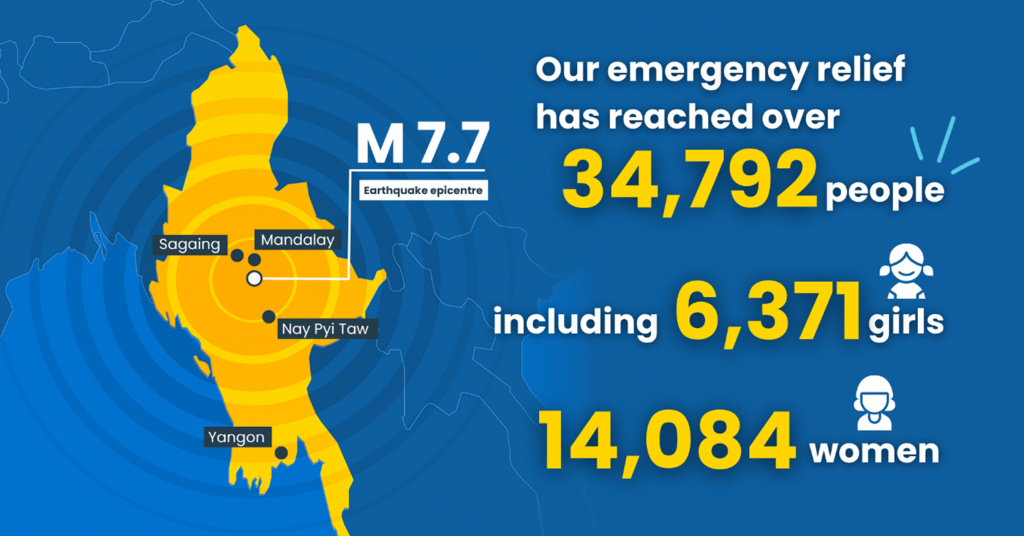
Our specific relief efforts are detailed below:
- Distributed 3,922 food packages, including biscuits, noodles, and rehydration drinks
- 2,869 households received drinking water, and we distributed 2,340 essential water containers, including jerry cans, buckets, tanks, and bottles
- Distributed 400 women’s essential kits
- 997 households received cash assistance
- 23 mobile toilets were set up to improve the safety and hygiene of shelters
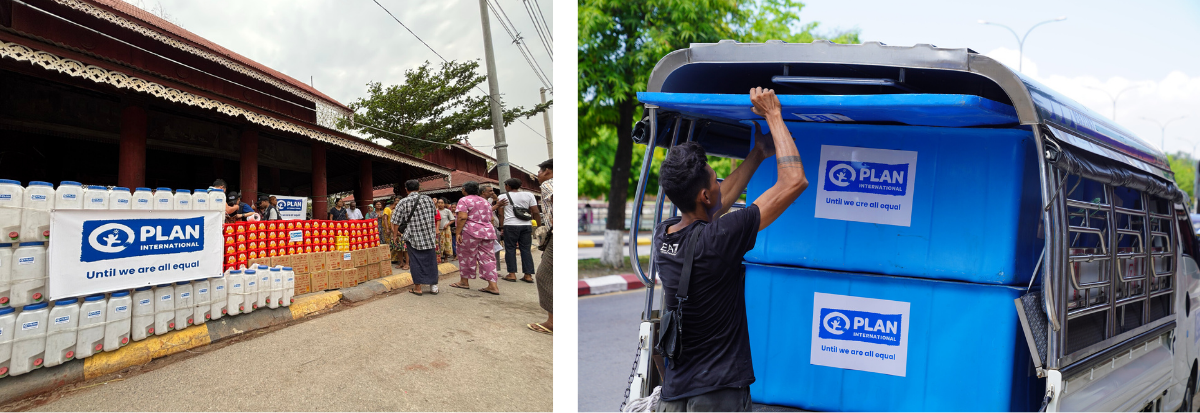
Since the earthquake, we have continued to support the affected children and their families, distributing food and clean drinking water promptly to alleviate their urgent needs.
Furthermore, the earthquake has taken a toll on the mental well-being of many children in the affected areas. To address this, we are currently running 21 child-friendly spaces, supporting child protection and education in emergencies. To date, 3,793 children have benefited from this work.
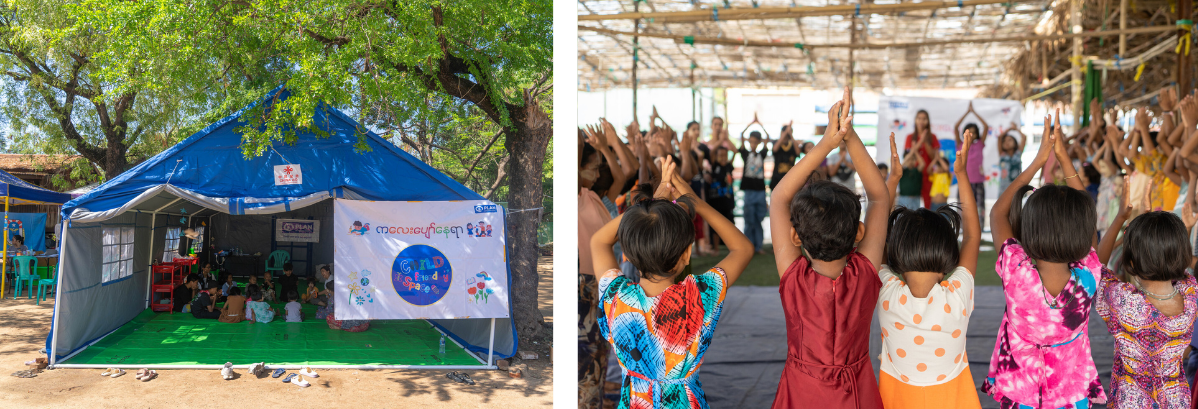
We set up 21 child-friendly spaces to create a safe environment for children, allowing them to learn, play, and laugh together.
At the same time, Plan International is also actively carrying out long-term projects to support sustainable development in the disaster area. This includes setting up three temporary learning spaces and renovating 12 schools damaged by the earthquake, so that the affected children can return to school and study with peace of mind, and we remain committed to improving the teaching quality and safety.
Case Story: The Girl Who Overcame Disaster to Offer Support
The road to recovery in the earthquake-stricken areas of Myanmar is long and challenging. Amidst the fear, loss, and uncertainty brought about by the earthquake, some bravely overcome it and focus on helping people in their community.
Nan (pseudonym) is a 23-year-old girl who experienced this disaster firsthand. “When the strong tremor hit, I had to escape in a hurry. People were scared and crying, and running around. I was shocked when the earthquake struck. I cried because I was scared; I was all by myself. I wasn’t with my family,” she recalled.
However, this tragic experience did not cause Nan to succumb to sadness; instead, she chose to move on by helping others. She said frankly, “If I let myself get too drawn in, there would be no future for me. Rather than dwelling on this, I should overcome it and focus on the things I can do for my future.” Because of this determination, coupled with her sister’s encouragement, she participated in Plan International’s training, hoping to become a volunteer and help children who have also experienced trauma to escape the haze. She modestly said, “As a young person myself, I would like to volunteer, as most young people do. Though I cannot afford financial support, there are still things I can do.”
After completing the training, Nan volunteered in the child-friendly space set up by Plan International. She observed, “Children are victims of the earthquake. In this neighbourhood, some children have been affected by fire as well; some have had their houses damaged and may be distressed. In this child-friendly space, the children are all different.”
Through playing with the children, drawing, and telling stories, Nan spent most days with the children in the community, helping them recover from their trauma. Nan shared, “This is my first time volunteering. I had never volunteered before. So, as I was free, I decided to participate and stay with the children to play, tell stories, and help them get over what happened.”
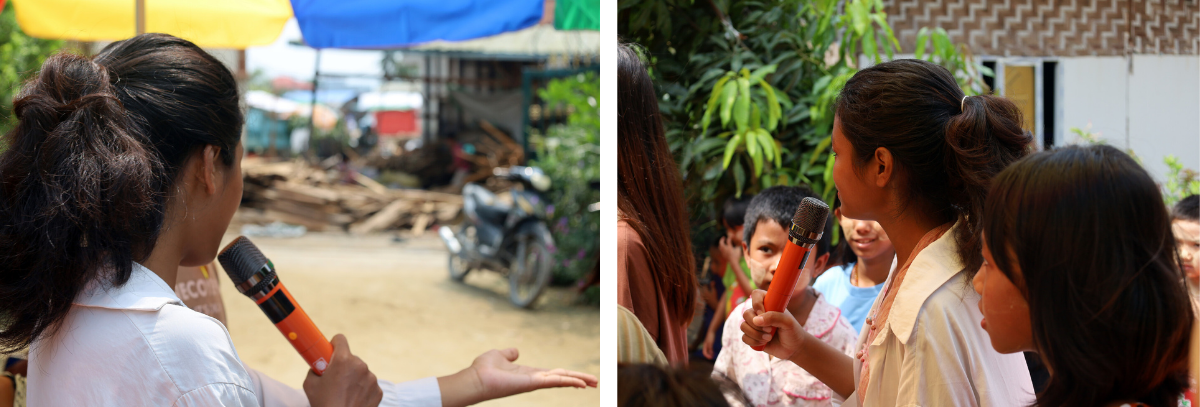
Faced with the pain brought by the earthquake, Nan chose to channel her trauma into helping others. Encouraged by her sister, she became a volunteer at Plan International’s child-friendly space, offering practical support to those in need.
Rebuilding will be a long and challenging journey. Currently, the most immediate needs in the disaster area are housing reconstruction, school repair, cash assistance, and child protection services. If you are interested in supporting our post-disaster relief work in Myanmar, please click here [Myanmar Earthquake Emergency Appeal] to learn more. Moving forward, Plan International will continue to collaborate with local partners to provide humanitarian assistance, educational support, and mental health services, helping victims to resume their normal lives as soon as possible.
